I want to be honest with you: I didn’t know what “impressions” meant six months ago.
I wasn’t tracking algorithms, studying viral formulas, or trying to game LinkedIn’s feed. I was just a Database Architect at Ericsson, writing about things I’d actually lived through — layoffs, investing, career decisions, technical learnings — hoping someone out there might find it useful.
Then something unusual happened.
The Post That Changed My Week
On August 3, 2026, at 1:38 AM, I published a post titled “Why I’m not scared of layoffs — and you shouldn’t be either.”
Layoff-Proof: My 5-Step Plan to Never Fear Job Loss Again – gradeupnow
I shared my real story. How I started a ₹5,000/month SIP back in 2012 after the financial crisis in 2008 when everyone around me was panicking. How I calculated that my family could live comfortably in Kolkata on ₹9 lakhs a year. How 21 years of consistent investing — not a high salary, not luck — gave me the freedom to look at layoff news without fear.
I didn’t expect much. My previous best post had reached around 25,000 people. A good day for me was 3,000–4,000 impressions.
Here is what actually happened:
- Day 1 (Aug 3): ~4,000 impressions. Quiet. Normal.
- Day 2 (Aug 4): Still modest. I barely checked it.
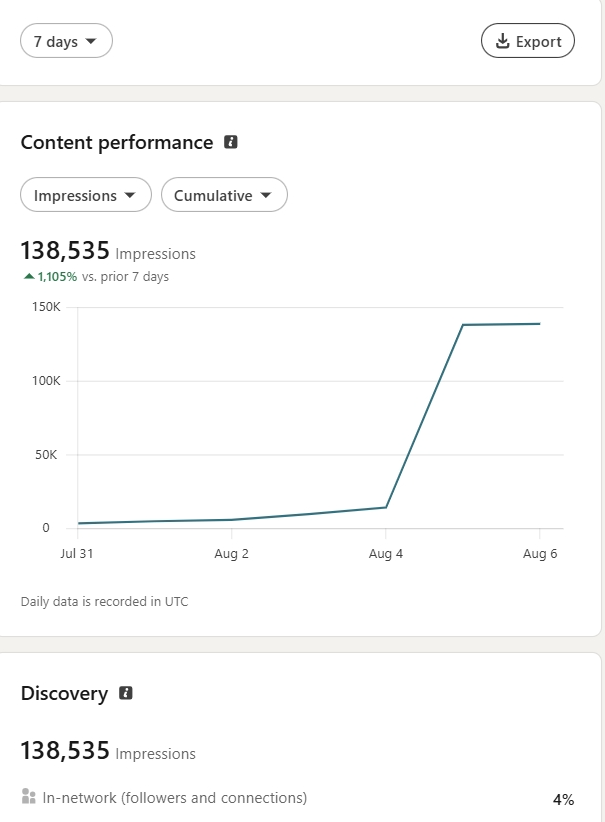
- Day 3 (Aug 5): 123,407 impressions in a single day.
And then, as fast as it climbed, it settled. By the time I checked again a day later, the numbers had barely moved — impressions crept up by less than a thousand, reactions actually dipped slightly. The cascade had run its course.
Here are the final, settled numbers:
- Total impressions: 126,905
- Members reached: 81,122
- 97% of those people had never seen my content before
- Reactions: 295 | Comments: 14 | Saves: 57 | Private sends: 28
- Profile views from this post alone: 1,869
- New followers directly from this post: 61
- Total followers: grew from 6,140 to 6,347 in a week
The moment I truly realised something unusual was happening? I opened LinkedIn and saw 30 connection requests arrive in under a minute. People were messaging me directly, praising the post, asking for career guidance, sharing their own fears about job security.
That’s when the number became real to me. Not the impressions figure — the human beings on the other side of it.
How Do You Know If a Post Is “Viral”?
I’ll be transparent about how we measured this, because I think it’s useful for anyone wanting to understand LinkedIn analytics.
LinkedIn provides a Post Analytics dashboard for every post. The key metrics to watch are:
- Impressions — how many times your post appeared on someone’s screen
- Members reached — unique people who saw it (always lower than impressions, since one person can see it multiple times)
- Out-of-network % — the percentage of viewers who do NOT follow you. This is arguably the most important virality signal. My post hit 97% out-of-network, meaning the algorithm was actively distributing it far beyond my existing 6,000+ followers.
- Saves — someone bookmarked your post to read later. This is a very high-intent signal.
- Sends on LinkedIn — someone privately forwarded your post to a specific person. Even stronger signal.
When saves and sends are high, the LinkedIn algorithm interprets it as “this content is genuinely useful” and keeps redistributing it — which is why this post kept growing for 3 days instead of the usual 48-hour decay window.
A post reaching 5x your follower count, with 97% out-of-network reach, sustained over multiple days — that qualifies as viral by any LinkedIn standard.
This Is What Compounding Actually Looks Like
Here’s the part I think matters more than the viral moment itself.
I’ve been on LinkedIn for close to 10 years. For most of that time, nothing looked like this. My posts before this year quietly reached a few hundred people. Some reached barely a few dozen. There was no dashboard telling me anything was building. It just felt like I was talking into a small room.
Here’s what a full year of daily impressions actually looks like:
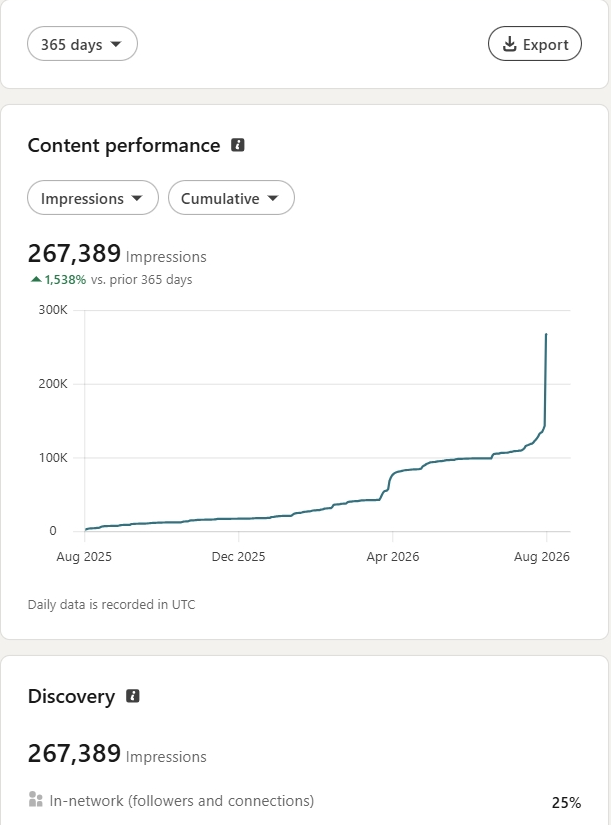
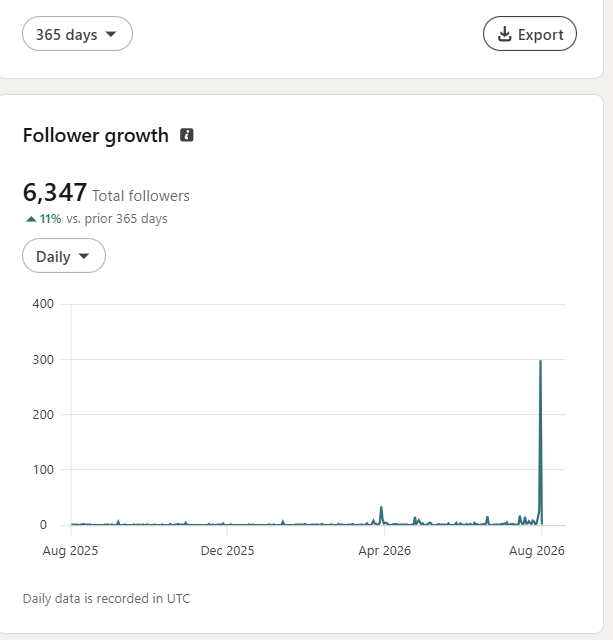
This my followers grew over one year
For eleven and a half months, the numbers barely register on this scale. Then, in the space of a single day, everything before it becomes a flat line at the bottom of the chart.
But that flat line is misleading. Zoom in with a 7-day rolling average on a log scale, and a completely different picture appears:
There were already waves happening all year — small ones in September, October, January, a bigger one in April, another building through July. Each wave was a little higher than the one before it. I wasn’t dormant for a year and then suddenly viral. I was building, testing, posting, learning what resonated, quietly raising my own baseline, one post at a time.
Now look at how my own “biggest posts of all time” list has shifted, just this year:
| Post | Date | Impressions |
|---|---|---|
| “Why I’m not scared of layoffs” | Aug 3, 2026 | 126,905 |
| Oracle leadership & layoffs | Apr 3, 2026 | 24,905 |
| “Completed 14 years at Ericsson” | Mar 28, 2026 | 10,700 |
| Personal finance / Kolkata cost-of-living | Jul 26, 2026 | 7,748 |
| “21 years of interviews” | Mar 29, 2026 | 5,098 |
| GenAI from scratch for DBAs | Jul 19, 2026 | 4,999 |
Notice something: this wasn’t my first post that reached tens of thousands of people. My April post about Oracle layoffs also broke my previous record at the time — 24,905 impressions, my personal best until this one. It actually still holds more total engagements (787) than this post did, because it had a smaller, more tightly-knit audience actively discussing it in the comments.
That’s the part nobody tells you about compounding: it doesn’t arrive as one big moment. It arrives as a series of slightly bigger moments, each one resetting what “normal” looks like for you.
A year ago, my “good day” was a few hundred impressions. Six months ago, breaking 10,000 felt enormous. Two weeks ago, 25,000 was my ceiling. This week, that ceiling became the floor.
My follower count tells the same story, just slower and quieter. It took me the better part of a decade to reach 6,000 followers. It took one post — riding on top of everything before it — to add over 200 in a single day. The follower growth wasn’t sudden. The conditions for it had been building for years; the post just happened to be the trigger.
This is exactly the same shape as my SIP. ₹5,000 a month starting in 2012 didn’t feel like anything for years. The account balance barely moved for a long time. Nobody looking at year two or year three would have predicted year eighteen. The growth was always happening — it just wasn’t visible yet. Then one day, the curve bends, and what took a decade to build shows up in a single week. Now that investment has grown to 20L in CAGR 13% return.
I didn’t get this post by writing harder than usual. I got it by writing consistently for years, so that when the algorithm decided to test this one post against a much larger audience, there was already a decade of credibility, a network of engaged connections, and a track record of real content sitting behind it. Virality didn’t create the compounding. It revealed compounding that was already there.
What I Did NOT Do
I want to address this directly because it matters.
When the messages and connection requests started flooding in, I did not pitch my services. I did not mention Perfinapp, my financial planning tool. I did not ask people to visit my blog. I did not offer paid consultations.
I simply responded warmly, thanked people, and kept the conversation human.
Why? Because right now, my LinkedIn is about connection, not conversion. I am in the business of sharing real stories and building genuine relationships. The professional opportunities — consulting, advisory, product work — will come later, when the trust has been earned over months and years, not days.
This is perhaps the most important lesson I can share.
What I Believe Made This Post Work
Looking back honestly, here is my assessment:
1. It was specific, not generic. Real numbers. Real years. Real decisions. ₹5,000/month SIP. ₹9 lakhs/year Kolkata budget. 2008 financial crisis. Specificity builds credibility that no amount of “motivational content” can match.
2. It named a fear people are already carrying. Layoff anxiety is real, especially in IT services right now. I didn’t manufacture the emotion — I simply acknowledged it and offered my honest perspective. People don’t save and share advice. They save and share relief.
3. It was consistent with everything else I post. This post didn’t come out of nowhere. It was built on the back of 10+ years of LinkedIn presence, consistent posting, and genuine engagement. The algorithm had already learned that my content gets engagement. This post just happened to trigger a much larger cascade.
4. I wrote it at 1:38 AM because I had something to say — not because it was “posting time.” Authenticity has no schedule.
Why Growing Your Network on LinkedIn Actually Matters
Before I get into practical advice, I want to address something honestly: it’s easy to dismiss LinkedIn growth as vanity metrics — chasing followers for the sake of a number. I used to think that too, for years. This week changed my mind, and not just because of the reach itself. Here’s what a real professional network actually gives you, based on what I’ve lived through:
It’s career insurance. The entire premise of the post that went viral was that I don’t fear layoffs — partly because of my finances, but also because I know I’m not invisible in my industry. A strong network means that if something ever does happen to your job, you are not starting from zero. People already know your work. Opportunities find you instead of you cold-applying into silence.
Opportunities come to you, not the other way around. In just the last few days, I’ve had software engineers with multiple cloud certifications message me directly, recruiters reach out about roles, including outside India, and people I’ve never met ask for career guidance. None of that happened because I applied for anything. It happened because I had been visible and consistent long enough for the right people to notice.
It compounds your learning, not just your reach. Every comment, every disagreement, every question someone asks under your post sharpens your own thinking. I’ve learned as much from explaining my SIP journey or my Oracle APEX learnings in public as the people reading them have. A network isn’t just an audience — it’s a feedback loop.
It builds credibility before you ever need it. I’m not planning to leave Ericsson soon, and I’m still not pitching any services. But when I eventually do move into consulting and financial advisory, I won’t be starting from a cold introduction. There will already be thousands of people who have seen years of my real thinking, not a polished sales pitch assembled the week I needed clients.
It connects you to people outside your current bubble. My daily work is inside one company, one team, one set of problems. My network spans database architects, DevOps engineers, recruiters, and people across TCS, Oracle, Accenture, Cognizant, and beyond. That range of perspective is not something any single job can give you.
It’s a hedge against how unpredictable careers actually are. Layoffs, restructuring, industry shifts — none of us fully control these. What we can control is whether people know we exist and know what we’re capable of, before we ever need that to matter.
None of this required me to be an influencer or treat LinkedIn like a full-time job. It required showing up consistently, for years, with real things to say. The network built itself around that.
What You Can Do To Grow Your LinkedIn Network
I’m not a LinkedIn coach. I’m a Database Architect who figured some of this out the hard way over a decade. But here is what I genuinely believe works:
Post consistently, not constantly. I aim for 2–3 posts per week — one personal/career experience, one technical topic, one finance or mixed topic. Quality over frequency, always.
Write from your own life. Your 15 years of experience as a developer, analyst, architect, or manager contains stories that no one else can tell. Don’t paraphrase what you read on Medium. Share what you lived.
Engage with others genuinely. Comment on posts in your field. Not “Great post!” — actual thoughts, additions, respectful disagreements. LinkedIn rewards conversations, not broadcasts.
Be patient. Genuinely patient. I have been posting on LinkedIn for close to 10 years. My follower count crossed 6,000 this year. Compounding doesn’t feel like anything for years — and then one day, it does.
Don’t chase virality. I never set out to write a viral post. I set out to share something true. The reach was a byproduct of authenticity, not a goal in itself. If you optimise for virality, you’ll write what you think people want to hear. Write what you know to be true instead.
A Final Thought
The most meaningful messages I received this week weren’t from people praising the reach or the numbers. They were from people who said: “I’ve been feeling this exact fear and didn’t know how to name it. Thank you.”
That is why I write.
If you’re sitting on years of real experience and you haven’t started sharing it yet — start today. Not because it might go viral. But because someone out there is waiting to hear exactly what you have lived through.
Your network is your net worth — but only if you invest in it consistently.
If this resonated with you, I’d love to hear your story in the comments. What’s the one experience from your professional life you’ve been meaning to write about but haven’t yet?
#LinkedIn #CareerGrowth #PersonalFinance #Networking #AuthenticContent #LinkedInGrowth #ITCareers #DatabaseArchitect #Layoffs #FinancialFreedom